
I recently posted about my summer running hiatus and getting back into running. One of the things that I’ve decided to do is ditch my concerns about pace and just focus on enjoying the run and getting back into shape.
For the first time ever, I’ve completely removed pace from my watch face, although I do check in on my average pace after the run. Instead of worrying about if I’m too fast or too slow, I’m working on dialing into how I feel.
The truth is, I really like data. I’ve always been more of a quantitative person than qualitative. I like to have numbers to compare and a metric to try to move.
If you’re like me, and running for feel just isn’t quite cutting it, here’s a few metrics you can focus on that aren’t pace.
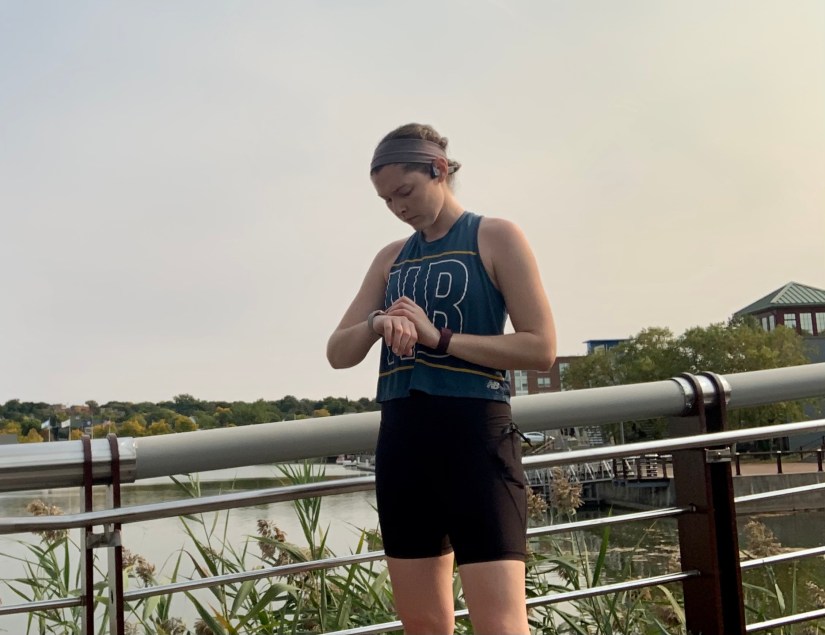
Cadence
Cadence is the number of steps you take in a minute. This is measured either by tracking the steps one foot takes or each individual step, which is why you may see a cadence of 90 or 180. (If you’re an Apple Watch user, it’s each individual steps.)
While it would be hard to say that everyone should be running with the same cadence, studies have shown that a higher cadence can decrease running related injuries and increase running efficiency. Many professional runners run with cadence of 180 spm (steps per minute) or higher. For the recreational runner, coaches like Greg McMillan believe the ideal cadence is actually somewhere between 170-190 spm. If your cadence is below 170, you may want to focus some energy on increasing it. I highly recommend Spotify’s running playlists, many of which are organized by beats per minute.
Heart Rate
You may have heard experts talk about “running for feel” or using “heart rate zones” to train. There is a lot of science that backs these things up, but no one has ever been able to tell me, “This is what your heart rate should be for an easy run.” I have always looked at my heart rate average after a run, but to be honest it hasn’t ever really meant a whole lot to me.
So, I did a little research.
There are a few different ways you can calculate your heart rate zones, but to start you’ll want to determine your resting heart rate and maximum heart rate. If you wear any sort of activity tracker or smart watch, you can likely look in your data to find out what your resting heart rate is. You can also figure it out the old school way by finding your pulse at your wrist or neck, counting the number of times your heart beats in 15 seconds, and multiplying that number by 4. It’s best to do this first thing in the morning when you wake up.
Your maximum heart rate (MHR) can be calculated a few ways:
You should get a pretty close result with either formula.
From there, you can start to determine your heart rate zones. Polar has established 5 different heart rate zones:
- Zone 1: 50-60% of MHR
- Zone 2: 60-70% of MHR
- Zone 3: 70-80% of MHR
- Zone 4: 80-90% of MHR
- Zone 5: 90-100% of MHR
If you’re looking for something a little simpler, Runner’s World has broken this down even further to just 3 zones:
- Training: 50-70% of MHR
- Tempo: 71-85% of MHR
- Intervals: >85% of MHR
Right now, I’m working on keeping my cadence in 170-180 spm range and my heart rate in the 140-155 range. If you are really brave (I am not) you could take off your watch entirely and just run for the thrill of running. The run does in fact count whether or not you have the data to prove it.
Whether you’re looking at your watch or not, I would also recommend keeping a training journal to document more qualitative things about your run.
- How was your run?
- How did you feel?
- What was the weather like?
- What time of day did you go?
- What did you eat before, if anything?
These are all things that might not seem super important right after your run, but over time you may actually notice some trends in what sets you up for a great run.
Cheers!
-Molly
 Molly Siskovic